A recent article by John Peterson argued that electric vehicles will take us backward in our efforts to reduce greenhouse gas emissions and that today's hybrid cars are more effective in reducing GHGs. Peterson's commentary rests on recent research by Carnegie Mellon University regarding life-cycle emissions of various vehicle types.
I believe Peterson's highly negative view of electric vehicles is unwarranted and inaccurate due to a number of reasons that I describe below.
I have some familiarity with these issues in that I represent the Green Power Institute (a non-profit policy outfit based in the Bay Area) at the California Public Utilities Commission in the electric vehicle proceeding R. 09-08-009. This proceeding is considering numerous issues related to utility rate design for electric vehicles and state policies for integrating potentially large numbers of electric vehicles into the grid in coming years. Our comments in this proceeding can be found here.
I also was the lead author of the Community Environmental Council’s 2007 report, A New Energy Direction: A Blueprint for Santa Barbara County, which examined in detail how Santa Barbara County could wean itself from fossil fuels and save substantial money at the same time. I wrote the report not only as a detailed blueprint for one county, but also as a template for other counties and regions contemplating similar goals. I wrote in that report that alternatives to driving, driving smaller vehicles, and relying on hybrid vehicles were the best short-term options for reducing fossil fuel use. However, in the longer term, electrification of our transportation infrastructure was the most promising path.
Read the rest at www.renewableenergyworld.com
Monday, January 24, 2011


Wednesday, January 5, 2011
On Solidity: Absent-Minded Science, Part III

For those of us who are contemplative, there is a tendency when encountering a philosophical system that is initially appealing to become overly excited. It is the system, the approach to explaining all of this (arms out-stretched), which we have been looking for and failed to find for so many years.
This happened to me a few years ago when I first encountered Alfred North Whitehead’s ideas. I’ve read widely in philosophy for decades now, but it was only when I was sufficiently inspired to write down my own ideas, my own theory of this, that I got serious about examining other serious theories. Whitehead was a British mathematician, logician, physicist, and philosopher. He spent the last decade or so of his academic life at the Harvard philosophy department and became, ironically, a key part of the American 20th Century philosophic tradition, along with William James, Charles Peirce, Josiah Royce, etc. Before then, he spent many years at Cambridge, where he famously collaborated with Bertrand Russell on the three-volume Principia Mathematica, a tour de force that attempted to reduce all of mathematics to simple logic. It failed, ultimately, but that’s a different story.
Whitehead is best-known today for his “process philosophy,” which he himself called the “philosophy of organism.” The basic idea of process philosophy, as with all Buddhist schools of thought, is that all of this is impermanent, flux, constant change – process. Whitehead wrote a number of books in the last phase of his career that fleshed out his incredibly rich philosophy. None is more rich – or more difficult – than his Process and Reality, which first appeared in 1929. This book presents Whitehead’s theory of everything and situates it within the Western tradition of John Locke, Spinoza, Kant, Schopenhauer, Hume, and others.
Whitehead’s system is compelling for a number of reasons, not least of which are its adequacy to the facts of human experience, its logical consistency, and the pedigree of its creator. It’s hard to find someone more qualified than Whitehead to create a comprehensive philosophical system, due to his background in mathematics, logic, and physics at the highest levels of academia.
Anyway, I became infatuated with Whitehead and his intellectual successors David Ray Griffin, John Cobb, Jr., Charles Hartshorne, and others, and here’s why.
Read the rest here or here.
Tuesday, November 9, 2010
Absent-minded Science, Part II: The Zombie Defense
And here's Part II of this seven-part series on absent-minded science:
Here’s a head-scratcher for you: Can zombies argue that they don’t exist? Empirical evidence suggests they can. Or does it?
The philosophy of mind is a thriving field in recent decades, with new books and articles appearing with increasing frequency. This article is the second in an occasional series on the role of mind in the universe and, thus, in science.
Strangely, modern science is dominated by the idea that to be scientific means to remove consciousness from our explanations in order to be “objective.” This was, of course, the rationale behind behaviorism, a now-dead theory of psychology that took this trend to a perverse extreme. Behaviorists like John B. Watson and B.F. Skinner scrupulously avoided any discussion of what their subjects thought, intended, or wanted and focused, instead, entirely on behavior. They believed that because thoughts in other people’s heads, or even in animals, are impossible to know with certainty, we should simply ignore them in our theories. We can only be truly scientific, they asserted, if we focus solely on what can be directly observed and measured: behavior.
This point of view is known most generally as “positivism,” which asserts that only those things we can measure directly should be part of our theories in science. Positivism has held sway in various branches of science to varying degrees over the last couple of centuries. Early in his career, Einstein was strongly inspired by Ernst Mach’s version of positivism, creating his special theory of relativity in 1905 partly as a response to this philosophy (and thus expelling the luminiferous ether from physics as “superfluous”). But Einstein learned better, rejecting positivism by the middle of his career as inadequate.
Read the rest at IONs
Absent-minded Science, Part I
This is an expanded version of an oped that ran earlier this year in the Independent. I'm now an "official" blogger for the Institute of Noetic Sciences, based in Petaluma. IONs, as they are known, is recently famous for being featured in Dan Brown's book, The Lost Symbol, due to the fact that some of their research is focused on parapsychology.
Absent-Minded Science, Part I
We learn from an early age that “to be scientific” means avoiding attributing to nature humanlike tendencies such as mind or purpose. To be “anthropomorphic” in science is a cardinal sin. Modern science, with its amazing successes in improving human understanding, did in fact spring in part from this tendency, made clear with Descartes’ philosophical separation of reality into two categories, physical stuff and mental stuff. The mental stuff is the realm of spirit, and this is God’s domain. The physical stuff is also God’s handiwork, but it works according to identifiable rules (laws) that humankind may discern through careful observation and experiment.
However, as with most big ideas, Descartes’ idea was overly simplistic and, we now know, inaccurate. Very few modern scientists or philosophers would argue in favor of Cartesian dualism, though this view is still fairly common among more religious-minded people. But its direct residue is “reductionist materialism,” which simply ignores the mental-spiritual realm that Descartes proposed and attempts instead to explain everything as simply matter in motion. Recent challenges to Cartesian dualism and reductionist materialism from a non-religious perspective come from such philosophers as Galen Strawson, David Chalmers, and David Ray Griffin, who realize that modern science went astray long ago by trying to expunge mind from its explanations.
The problem becomes apparent when we try to explain mind itself within the “scientific method,” which does its best to ignore mind in nature. The prevailing theory of mind argues that mind emerges from mindless matter when a certain level of complexity is reached in both evolutionary history and in each organism. That is, at some point in the history of life on our planet, a mind appeared for the first time where it was wholly absent before. In this view, the constituents of matter are completely devoid of mind until the required level of complexity is reached – whether physicists decide that matter is ultimately comprised of quarks, energy, fields, strings, or what have you.
But here’s the problem: It is literally impossible for mind to spring forth from that which is wholly devoid of mind.
Read the rest at IONs
Tuesday, October 5, 2010
Process philosophy, Buddhism and Western science

This is a talk I gave to a small group of academics and Buddhist practitioners and teachers at UC Santa Barbara. The group's purpose is to discuss the intersection of Western science and Buddhism. I suggested that process philosophy, the Western tradition championed by Alfred North Whitehead, Henri Bergson, David Ray Griffin and many others, is a very good bridge between these domains, with some interesting commonalities and distinctions. Many of the pictures got lost in this pdf conversion, but the message still comes through.
Tuesday, September 28, 2010
Burning Man, Abundance and Utopia

Burning Man is a riotous, yet organized, annual celebration of music, art and excess held in the Nevada desert. It attracts about 50,000 visitors and becomes the third or fourth largest city in Nevada for one week each year. But while Burning Man celebrates certain types of excess, it also emphasizes stewardship of our planet’s limited resources through various means.
This is my third peregrination to Black Rock City, the artificial city that springs up each year to accommodate the revelers. This year’s art theme, chosen by the organizers, was Metropolis, which was intended to induce some thought about how communities develop and how people get along with each other and their environment. The city itself is laid out each year on the completely flat plane of a dry lakebed. It’s a horseshoe-shaped city three miles across — a lot of room for revelers but obviously not unlimited room. Kinda like our planet.
Read the rest at Noozhawk.
Sunday, September 12, 2010
Kicking the Psychophysical Laws Into Gear
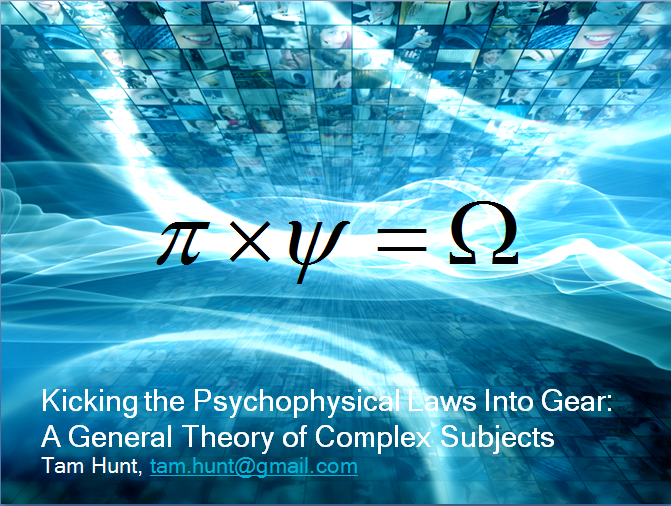
This is a presentation I gave to the UC Santa Barbara Psychology Department, at the invitation of Professor Jonathan Schooler, a co-thinker of mine in many ways, as well as a partner in crime on many adventures. The presentation is a distillation of my unfortunately rather long paper that has been accepted for publication by the Journal of Consciousness Studies. The very quick summary: all matter is experiential and is thus better described as "menter"; the experiential units of menter are determined by a particular type of field coherence that leads to a "shared sampling rate with respect to reality." It's all about coherence and it may be the case that quantum coherence is at the heart of human consciousness and the arisal of experiential units more generally (my theory is meant to be a general theory, meaning it should apply equally well in all times, in all places and to all groupings of matter/menter).
Subscribe to:
Posts (Atom)