Tuesday, October 5, 2010

Process philosophy, Buddhism and Western science


This is a talk I gave to a small group of academics and Buddhist practitioners and teachers at UC Santa Barbara. The group's purpose is to discuss the intersection of Western science and Buddhism. I suggested that process philosophy, the Western tradition championed by Alfred North Whitehead, Henri Bergson, David Ray Griffin and many others, is a very good bridge between these domains, with some interesting commonalities and distinctions. Many of the pictures got lost in this pdf conversion, but the message still comes through.

Tuesday, September 28, 2010

Burning Man, Abundance and Utopia


Burning Man is a riotous, yet organized, annual celebration of music, art and excess held in the Nevada desert. It attracts about 50,000 visitors and becomes the third or fourth largest city in Nevada for one week each year. But while Burning Man celebrates certain types of excess, it also emphasizes stewardship of our planet’s limited resources through various means.

This is my third peregrination to Black Rock City, the artificial city that springs up each year to accommodate the revelers. This year’s art theme, chosen by the organizers, was Metropolis, which was intended to induce some thought about how communities develop and how people get along with each other and their environment. The city itself is laid out each year on the completely flat plane of a dry lakebed. It’s a horseshoe-shaped city three miles across — a lot of room for revelers but obviously not unlimited room. Kinda like our planet.

Read the rest at Noozhawk.

Sunday, September 12, 2010

Kicking the Psychophysical Laws Into Gear


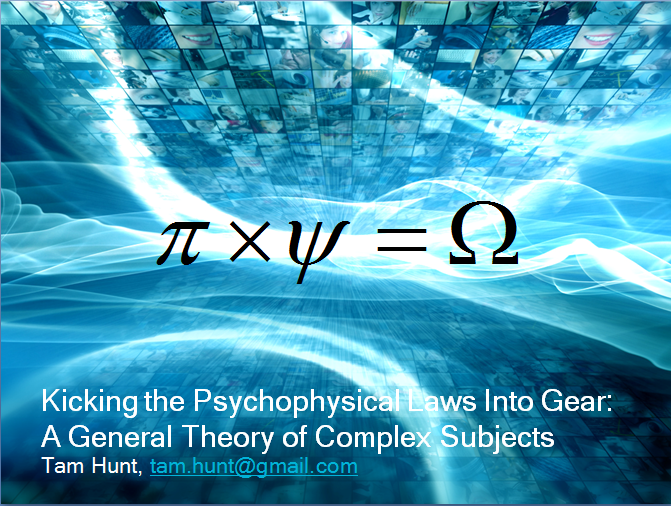
This is a presentation I gave to the UC Santa Barbara Psychology Department, at the invitation of Professor Jonathan Schooler, a co-thinker of mine in many ways, as well as a partner in crime on many adventures. The presentation is a distillation of my unfortunately rather long paper that has been accepted for publication by the Journal of Consciousness Studies. The very quick summary: all matter is experiential and is thus better described as "menter"; the experiential units of menter are determined by a particular type of field coherence that leads to a "shared sampling rate with respect to reality." It's all about coherence and it may be the case that quantum coherence is at the heart of human consciousness and the arisal of experiential units more generally (my theory is meant to be a general theory, meaning it should apply equally well in all times, in all places and to all groupings of matter/menter).

Tuesday, August 24, 2010

Mind, World, God: Science and Spirit in the 21st Century


This is a pre-print of my first book. It attempts a new integration of science and spirituality that is heavily inspired by process philosophy in Western thought and Vedanta and Buddhism in the East.

Friday, August 13, 2010

Absent-Minded Science

We learn from an early age that “to be scientific” means avoiding attributing to nature human-like tendencies such as mind or purpose. To be “anthropomorphic” in science is a cardinal sin. Modern science, with its amazing successes in improving human understanding, did in fact spring in part from this practice, made crystal clear with Descartes’ philosophical separation of reality into two categories: physical stuff and mental stuff. The mental stuff is the realm of spirit and this is God’s domain. The physical stuff is also God’s handiwork but it works according to identifiable rules (laws) that humankind may discern through careful observation and experiment.

However, as with most big ideas, Descartes’ idea was overly simplistic and, we now know, inaccurate. Very few modern scientists or philosophers would argue in favor of Cartesian dualism (though this view is still fairly common among more religious-minded people) but its direct residue is “reductionist materialism,” which simply ignores the mental/spiritual realm that Descartes proposed and attempts, instead, to explain everything as simply matter in motion. The recent challenge to Cartesian dualism and reductionist materialism (from a non-religious perspective) comes from those who realize that modern science went astray long ago by trying to expunge mind from its explanations.

The problem becomes apparent when we try to explain mind itself within the “scientific” method which does its best to ignore mind in nature. The prevailing theory argues that mind emerges from mindless matter when a certain level of complexity is reached, in both evolutionary history and in each organism. That is, at some point in the history of life on our planet, a mind appeared for the first time where it was wholly absent before. Matter itself is completely devoid of mind, in this view—whether physicists decide that matter is ultimately comprised of quarks and other little chunks, energy, fields, strings, or what-have-yous.

But here’s the problem: It is literally impossible for mind to spring forth from that which is wholly devoid of mind. This problem becomes clear if we envision the ultimate constituents of matter as akin to little billiard balls. (This is not an accurate notion, even in terms of the prevailing views of matter, but it is accurate in terms of my point here). No matter how we arrange any number of the little billiard balls, the collection will never give rise to any type of mind—unless there is some type of mind contained in the little billiard balls from the get-go. And the prevailing theory of mind today denies that there is any mind at all in the little billiard balls or any of the ultimate constituents of matter.

Read the rest at the Independent.

The Feed-in Tariff Discussion Heats Up

The Gulf oil spill catastrophe is an ongoing tragedy. And while the well seems to be capped now, we will surely see the harm from the spilled oil unfold for many months and years to come. From all tragedy springs opportunity, however, and one positive outcome flowing from BP's unfortunate accident is a renewed focus on energy and climate change, at least among some of the saner segments of the American populace.

The federal climate change bill appears to be dead this session, the victim of partisan politics in defiance of good sense. Other efforts are more promising, including a growing national focus on feed-in tariffs as a key policy tool for promoting renewable energy. A feed-in tariff is a guaranteed price paid for renewable energy projects that meet certain criteria. Contrary to what many believe, a feed-in tariff doesn't have to be an "above-market" price. The key features of feed-in tariffs are what I just mentioned: a guaranteed price for those projects that meet defined criteria.

California, often the leader on energy policy, is not in fact in the lead on feed-in tariff policy. Rather, municipalities like Gainesville, Florida and Sacramento, and states such as Vermont, Washington state and Oregon, are leading the charge on feed-in tariffs. Further to our north, the province of Ontario has the most robust feed-in tariff program in North America, similar to the European model that has proven so successful in Germany, Italy, Spain, Czech Republic and many other countries.

California is, however, leading in one key area related to feed-in tariffs. The California Public Utilities Commission recently filed a declaratory order request with the Federal Energy Regulatory Commission (FERC). This kind of action asks FERC to decide on a legal dispute before it makes it to the courts, hopefully heading off legal action. The CPUC asked FERC to decide if a limited new feed-in tariff, applicable only to cogeneration facilities under 20 megawatts, was preempted by federal law.

See the rest at GreenTechMedia

Wednesday, June 30, 2010

The Unipolar Moment Reconsidered

Columnist Charles Krauthammer wrote in 2004 that the predominance of U.S. power in the world after the fall of the Soviet Union was a “staggering development in history, not seen since the fall of Rome.” Krauthammer and his fellow neoconservatives famously concluded from this disparity in power that the United States needed to adopt an aggressive foreign policy agenda to enhance and continue its dominance in the “New American Century.”

This conclusion was the wrong lesson from history and from any reasonable and compassionate view of the desirable future arc of humanity. Rather than consolidate and expand U.S. power in the 21st century, with a mix of military, economic and cultural coercion — the neocon strategy — the United States should instead seize what is still our unique unipolar moment and work toward a truly multilateral and multipolar world.

The last two centuries have been dominated by one nation — the hegemon, which comes from the Greek for “leader.” Britain was the first global hegemon, and indeed the “sun never set on the British empire.” Britain’s dominance was fueled, literally, by coal, which allowed the industrial revolution to work its magic first in Britain. This led to great economic might, which was translated into military might. With a sense of cultural superiority, the “White Man’s Burden,” the British empire was ruthless in its domination of areas of the world as far-flung as North America, India, Jamaica, Gibraltar and Australia. Britain at its peak, however, never comprised more than 10 percent of the global economy.

The United States, fueled by coal and oil, which was first found in Titusville, Pa., in 1859, an expansive and ever-growing territory that spanned a whole continent, and a sense of “American exceptionalism,” was the successor to the British empire, reaching 19 percent of global economic output in 1913, at the verge of World War I, and 35 percent at the height of World War II. The United States is now about 20 percent of the global economy, its share shrinking as other nations grow rapidly. The United States’ historical wealth of oil, coal and natural gas allowed it to grow to such a dominant economic and military position that it is truly deserving of being called an empire.

See Noozhawk for the rest of this piece.