And here's Part II of this seven-part series on absent-minded science:
Here’s a head-scratcher for you: Can zombies argue that they don’t exist? Empirical evidence suggests they can. Or does it?
The philosophy of mind is a thriving field in recent decades, with new books and articles appearing with increasing frequency. This article is the second in an occasional series on the role of mind in the universe and, thus, in science.
Strangely, modern science is dominated by the idea that to be scientific means to remove consciousness from our explanations in order to be “objective.” This was, of course, the rationale behind behaviorism, a now-dead theory of psychology that took this trend to a perverse extreme. Behaviorists like John B. Watson and B.F. Skinner scrupulously avoided any discussion of what their subjects thought, intended, or wanted and focused, instead, entirely on behavior. They believed that because thoughts in other people’s heads, or even in animals, are impossible to know with certainty, we should simply ignore them in our theories. We can only be truly scientific, they asserted, if we focus solely on what can be directly observed and measured: behavior.
This point of view is known most generally as “positivism,” which asserts that only those things we can measure directly should be part of our theories in science. Positivism has held sway in various branches of science to varying degrees over the last couple of centuries. Early in his career, Einstein was strongly inspired by Ernst Mach’s version of positivism, creating his special theory of relativity in 1905 partly as a response to this philosophy (and thus expelling the luminiferous ether from physics as “superfluous”). But Einstein learned better, rejecting positivism by the middle of his career as inadequate.
Read the rest at IONs
Tuesday, November 9, 2010


Absent-minded Science, Part I
This is an expanded version of an oped that ran earlier this year in the Independent. I'm now an "official" blogger for the Institute of Noetic Sciences, based in Petaluma. IONs, as they are known, is recently famous for being featured in Dan Brown's book, The Lost Symbol, due to the fact that some of their research is focused on parapsychology.
Absent-Minded Science, Part I
We learn from an early age that “to be scientific” means avoiding attributing to nature humanlike tendencies such as mind or purpose. To be “anthropomorphic” in science is a cardinal sin. Modern science, with its amazing successes in improving human understanding, did in fact spring in part from this tendency, made clear with Descartes’ philosophical separation of reality into two categories, physical stuff and mental stuff. The mental stuff is the realm of spirit, and this is God’s domain. The physical stuff is also God’s handiwork, but it works according to identifiable rules (laws) that humankind may discern through careful observation and experiment.
However, as with most big ideas, Descartes’ idea was overly simplistic and, we now know, inaccurate. Very few modern scientists or philosophers would argue in favor of Cartesian dualism, though this view is still fairly common among more religious-minded people. But its direct residue is “reductionist materialism,” which simply ignores the mental-spiritual realm that Descartes proposed and attempts instead to explain everything as simply matter in motion. Recent challenges to Cartesian dualism and reductionist materialism from a non-religious perspective come from such philosophers as Galen Strawson, David Chalmers, and David Ray Griffin, who realize that modern science went astray long ago by trying to expunge mind from its explanations.
The problem becomes apparent when we try to explain mind itself within the “scientific method,” which does its best to ignore mind in nature. The prevailing theory of mind argues that mind emerges from mindless matter when a certain level of complexity is reached in both evolutionary history and in each organism. That is, at some point in the history of life on our planet, a mind appeared for the first time where it was wholly absent before. In this view, the constituents of matter are completely devoid of mind until the required level of complexity is reached – whether physicists decide that matter is ultimately comprised of quarks, energy, fields, strings, or what have you.
But here’s the problem: It is literally impossible for mind to spring forth from that which is wholly devoid of mind.
Read the rest at IONs
Tuesday, October 5, 2010
Process philosophy, Buddhism and Western science

This is a talk I gave to a small group of academics and Buddhist practitioners and teachers at UC Santa Barbara. The group's purpose is to discuss the intersection of Western science and Buddhism. I suggested that process philosophy, the Western tradition championed by Alfred North Whitehead, Henri Bergson, David Ray Griffin and many others, is a very good bridge between these domains, with some interesting commonalities and distinctions. Many of the pictures got lost in this pdf conversion, but the message still comes through.
Tuesday, September 28, 2010
Burning Man, Abundance and Utopia

Burning Man is a riotous, yet organized, annual celebration of music, art and excess held in the Nevada desert. It attracts about 50,000 visitors and becomes the third or fourth largest city in Nevada for one week each year. But while Burning Man celebrates certain types of excess, it also emphasizes stewardship of our planet’s limited resources through various means.
This is my third peregrination to Black Rock City, the artificial city that springs up each year to accommodate the revelers. This year’s art theme, chosen by the organizers, was Metropolis, which was intended to induce some thought about how communities develop and how people get along with each other and their environment. The city itself is laid out each year on the completely flat plane of a dry lakebed. It’s a horseshoe-shaped city three miles across — a lot of room for revelers but obviously not unlimited room. Kinda like our planet.
Read the rest at Noozhawk.
Sunday, September 12, 2010
Kicking the Psychophysical Laws Into Gear
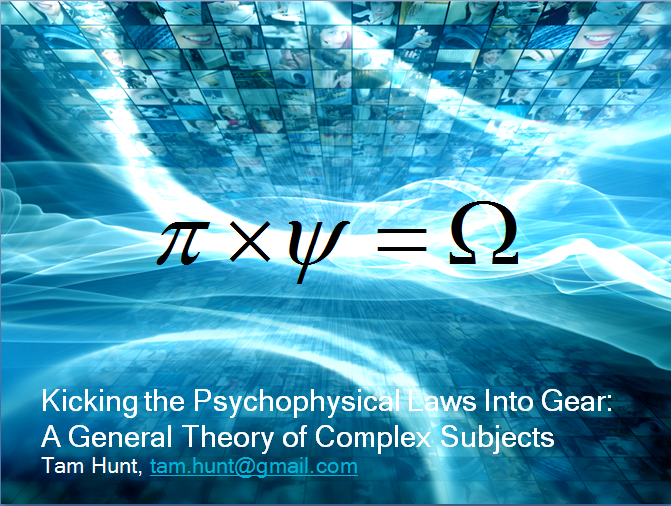
This is a presentation I gave to the UC Santa Barbara Psychology Department, at the invitation of Professor Jonathan Schooler, a co-thinker of mine in many ways, as well as a partner in crime on many adventures. The presentation is a distillation of my unfortunately rather long paper that has been accepted for publication by the Journal of Consciousness Studies. The very quick summary: all matter is experiential and is thus better described as "menter"; the experiential units of menter are determined by a particular type of field coherence that leads to a "shared sampling rate with respect to reality." It's all about coherence and it may be the case that quantum coherence is at the heart of human consciousness and the arisal of experiential units more generally (my theory is meant to be a general theory, meaning it should apply equally well in all times, in all places and to all groupings of matter/menter).
Tuesday, August 24, 2010
Mind, World, God: Science and Spirit in the 21st Century

This is a pre-print of my first book. It attempts a new integration of science and spirituality that is heavily inspired by process philosophy in Western thought and Vedanta and Buddhism in the East.
Friday, August 13, 2010
Absent-Minded Science
We learn from an early age that “to be scientific” means avoiding attributing to nature human-like tendencies such as mind or purpose. To be “anthropomorphic” in science is a cardinal sin. Modern science, with its amazing successes in improving human understanding, did in fact spring in part from this practice, made crystal clear with Descartes’ philosophical separation of reality into two categories: physical stuff and mental stuff. The mental stuff is the realm of spirit and this is God’s domain. The physical stuff is also God’s handiwork but it works according to identifiable rules (laws) that humankind may discern through careful observation and experiment.
However, as with most big ideas, Descartes’ idea was overly simplistic and, we now know, inaccurate. Very few modern scientists or philosophers would argue in favor of Cartesian dualism (though this view is still fairly common among more religious-minded people) but its direct residue is “reductionist materialism,” which simply ignores the mental/spiritual realm that Descartes proposed and attempts, instead, to explain everything as simply matter in motion. The recent challenge to Cartesian dualism and reductionist materialism (from a non-religious perspective) comes from those who realize that modern science went astray long ago by trying to expunge mind from its explanations.
The problem becomes apparent when we try to explain mind itself within the “scientific” method which does its best to ignore mind in nature. The prevailing theory argues that mind emerges from mindless matter when a certain level of complexity is reached, in both evolutionary history and in each organism. That is, at some point in the history of life on our planet, a mind appeared for the first time where it was wholly absent before. Matter itself is completely devoid of mind, in this view—whether physicists decide that matter is ultimately comprised of quarks and other little chunks, energy, fields, strings, or what-have-yous.
But here’s the problem: It is literally impossible for mind to spring forth from that which is wholly devoid of mind. This problem becomes clear if we envision the ultimate constituents of matter as akin to little billiard balls. (This is not an accurate notion, even in terms of the prevailing views of matter, but it is accurate in terms of my point here). No matter how we arrange any number of the little billiard balls, the collection will never give rise to any type of mind—unless there is some type of mind contained in the little billiard balls from the get-go. And the prevailing theory of mind today denies that there is any mind at all in the little billiard balls or any of the ultimate constituents of matter.
Read the rest at the Independent.
Subscribe to:
Posts (Atom)